Do You Need a BER Certificate to Sell in Lucan? Here’s the Answer
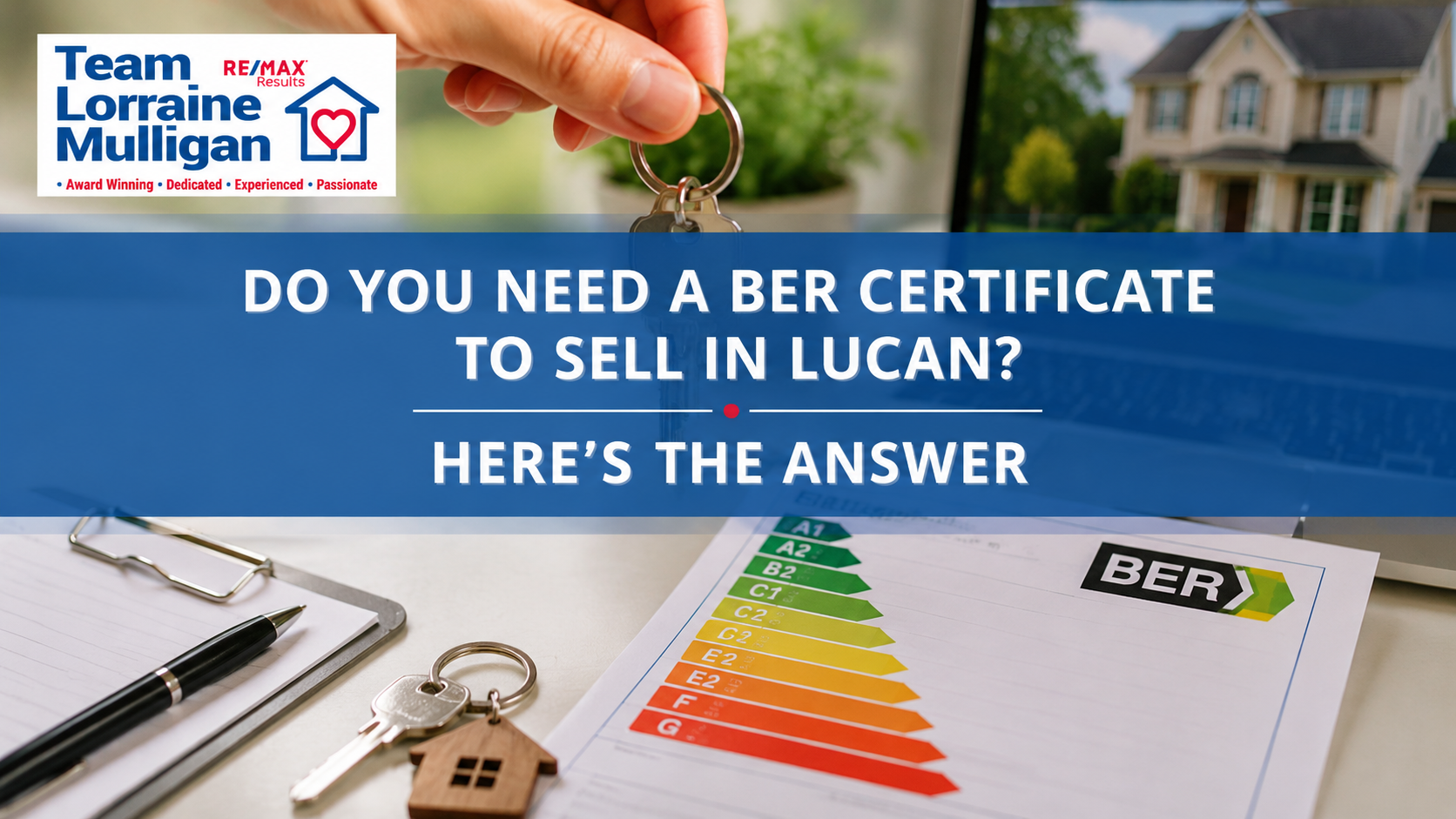
Do You Need a BER Certificate to Sell a House in Lucan?
Yes — a valid BER certificate in Lucan is a legal requirement before you can advertise your home for sale. The rating, BER number and energy performance indicator must appear in every listing. A SEAI-registered assessor carries out the survey, and the certificate then stays valid for ten years.
If you are preparing to list, this is one of the first boxes to tick. Leave it late and it holds up your photography, your Daft and MyHome listings, and your launch date.
What a BER Certificate Actually Measures
A Building Energy Rating scores how much energy your home is expected to use for heating, hot water, ventilation and lighting.
The assessment looks at insulation levels, windows, the heating system, ventilation and the overall building fabric. It is a rating of the property itself, not of how you personally use it.
Alongside the certificate you receive an advisory report, which lists the upgrades likely to give the best return. That report is useful well beyond the sale.
The Rules That Apply When You Advertise
Under the BER regulations, every sales advertisement must display the rating prominently. In practice, your estate agent needs three things from you before the property goes live:
- The BER rating motif — the emblem and rating letter
- The BER number — the nine-digit identifier on the certificate
- The energy performance indicator (EPI) — the kWh/m²/yr figure
Enforcement sits with the local Building Control Authority, and non-compliance can carry fines. Beyond the legal exposure, an incomplete listing also looks careless to buyers scrolling dozens of properties.
Are Any Properties Exempt?
A small number are. Protected structures, national monuments, places of worship, certain agricultural and industrial buildings, and standalone buildings under 50 square metres fall outside the requirement.
Almost every standard home in Lucan — from the older stock around the village to the newer estates — needs one.
Important: The BER Scale Changed in May 2026
From 24 May 2026, Ireland moved to a simplified BER scale. The fifteen sub-categories were replaced with eight straightforward bands.
This matters for sellers because buyers are now comparing homes on a scale that looks different from the one they remember.
| Previous scale | Scale from 24 May 2026 | |
|---|---|---|
| Number of bands | 15 (A1–G, with sub-levels) | 8 (A0, A, B, C, D, E, F, G) |
| Sub-categories | B1, B2, B3 and similar | Removed |
| Top band | A1 | A0 — highly efficient, no fossil fuels |
| Grant thresholds | B2 standard | B standard (same efficiency level) |
| Existing certificates | — | Remain fully valid for their 10 years |
| Certificate features | Standard cert | Includes a QR code linking to upgrade guidance |
Crucially, if you already hold a valid BER, you do not need a new one. It continues to satisfy the requirement until it expires.
How to Get a BER Certificate in Lucan
- Check whether you already have one. Search the SEAI National BER Register using your BER number or Meter Point Reference Number — many homes were assessed within the last decade
- Choose a SEAI-registered assessor. Only registered assessors can legally issue a certificate; it is worth getting two or three quotes
- Gather your documentation. Insulation specs, window details, boiler and heating records, and any upgrade invoices all help
- Host the survey. The assessor measures the building elements, inspects the heating system and photographs key features
- Receive your certificate and advisory report. Usually issued within a few working days
- Send it to your agent before any marketing goes live
What It Typically Costs and How Long It Takes
Fees vary by property size, age and location. Published guidance for 2026 puts most residential assessments in the region of €150 to €350, with a typical three-bed semi around the middle of that range and period properties at the upper end.
The on-site visit generally takes between one and three hours. Consequently, the realistic bottleneck is scheduling the assessor, not the assessment itself — which is exactly why it should be booked early.
Does a Low Rating Hurt Your Sale?
Not as much as sellers fear. Plenty of homes across Lucan sit in the D and E range simply because of when they were built, and buyers know it.
What genuinely damages a sale is surprise. A rating disclosed upfront, with an honest explanation of what has and has not been upgraded, is far easier for a buyer to price than one that emerges late.
That said, some improvements are worth making before you list:
- Attic insulation — usually the cheapest meaningful gain
- Draught-proofing — low cost, quick to complete
- Heating controls — modern zoning and timers can shift the rating
- Boiler servicing and documentation — evidence matters to the assessor
- Cavity wall insulation — a bigger job, but a significant improvement where suitable
Whether any of these make commercial sense depends on your property, your timeline and your likely buyer. It is a conversation worth having with your agent before you spend anything.
Where This Sits in Your Wider Selling Timeline
Your BER belongs at the very start of the process, alongside requesting your title deeds and locating planning paperwork.
Lorraine Mulligan, Broker at Team Lorraine / RE/MAX and a 27-year veteran Lucan estate agent, treats it as a week-one task with every seller. Across more than 7,000 property sales, the pattern is consistent: the sellers who handle documentation early are the ones who launch on time.
One recent seller put it simply: “I didn’t even know I needed a BER cert until Lorraine flagged it early on — she had it sorted within the first week so it never held up my listing.”
That kind of practical, ahead-of-the-curve guidance runs through Team Lorraine’s 400 Google five-star reviews.
Frequently Asked Questions
Ten years from the date of issue. If you had an assessment carried out within the last decade, you may already hold a valid certificate — check the SEAI National BER Register before paying for a new one. However, you will need a fresh assessment if you have made structural changes or replaced the heating system since.
No. The rating must appear in your advertising, so the certificate needs to exist before your property goes live on Daft, MyHome or any other platform. Book the assessment as soon as you decide to sell and it will never become the thing holding up your launch.
No. Certificates issued under the previous scale remain fully valid for their ten-year term and can still be used for a sale. The simplified eight-band scale applies to new assessments carried out from 24 May 2026 onwards.
Sometimes. Low-cost measures such as attic insulation and draught-proofing can shift a rating for modest outlay. Larger works rarely pay for themselves within a sale timeline. Get your assessment first, then review the advisory report with your agent before committing to any spend.
Get Sale-Ready Before Day One
A BER certificate is a small administrative task that quietly controls when you can launch. Handled in week one, it is a non-event. Handled late, it costs you weeks of market momentum.
From BER certification to a full documentation review, Team Lorraine / RE/MAX Lucan helps sellers arrive at launch day with everything already in place.
Contact Lorraine Mulligan at Team Lorraine / RE/MAX 📞 +353 1 627 2770 🌐 www.TeamLorraine.ie — book a FREE 2026 Market Strategy Session ✉️ lorraine@teamlorraine.ie 🌐 https://teamlorraine.ie/ 📍 Main St, Celbridge, Co Kildare | Unit 2, Lower Main Street, Lucan, Co Dublin